
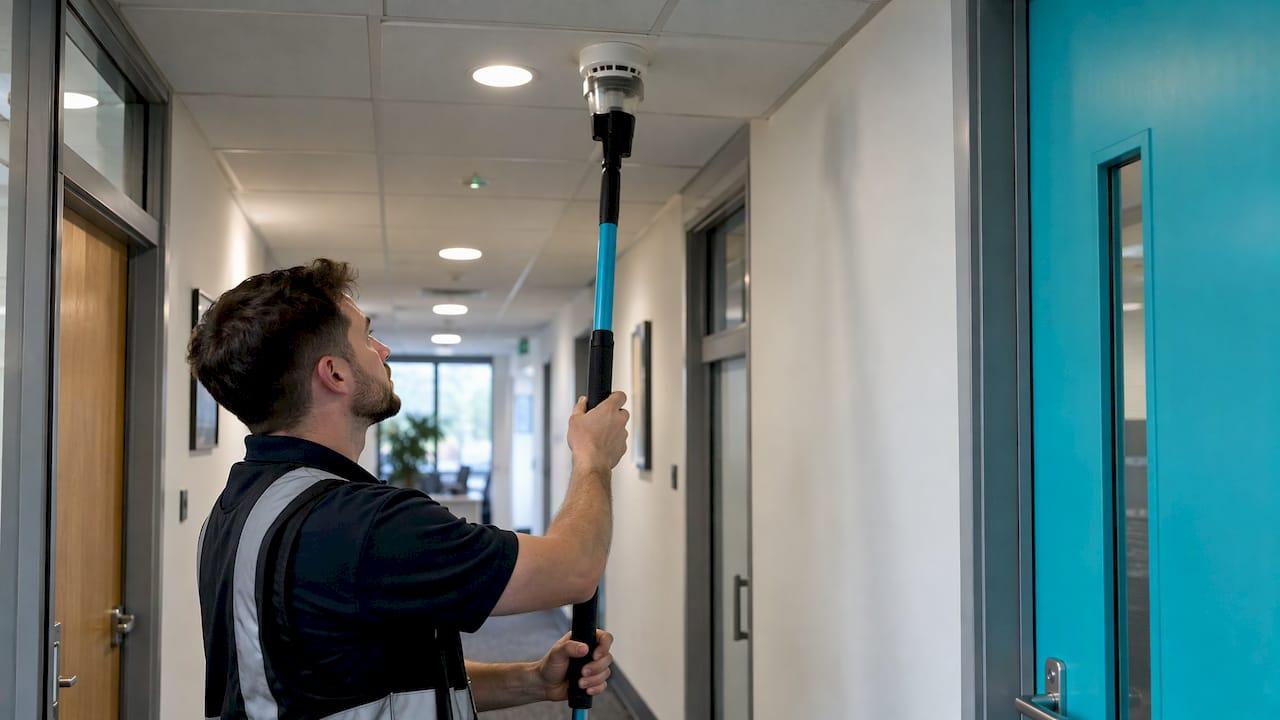
If you run business premises in England or Wales, your fire alarm needs a weekly user test and a service by a competent person at least every six months. Every visit should leave you with a certificate and an updated logbook. This guide explains what servicing involves, who can do it, what it should cover and which records to keep.
TL;DR
- The responsible person must keep the fire alarm in efficient working order under the Regulatory Reform (Fire Safety) Order 2005.
- Test one call point every week, using a different one each time. A competent person should inspect and service the system at intervals of no more than six months.
- A proper visit tests every call point and detector, looks for faults and building changes, and ends with a servicing certificate.
- Keep a logbook and certificates on site. The fire and rescue service can ask to see them.
- We service fire alarms and emergency lighting across the UK, with certificates normally within 24 to 48 hours.
Table of Contents
- What fire alarm servicing involves
- Your legal duty as the responsible person
- How often a commercial fire alarm needs testing and servicing
- What a servicing visit should include
- Who counts as a competent person
- Records: the logbook and certificates
- Fire alarm servicing with National Test Services
- Choosing a servicing arrangement that fits your premises
- FAQ
- Sources
What fire alarm servicing involves
Servicing is the planned inspection, testing and repair work that keeps a fire detection and alarm system doing the job it was installed for. It is different from the quick weekly test you run yourself. A service is a full check by someone trained to find problems that a weekly button press will not reveal: a detector that no longer responds, a sounder that is too quiet in one corner, a wiring fault, or a room that was partitioned and now has no cover.
It also protects against false alarms. The Home Office guide for people with fire safety duties says systems should be installed, managed and maintained so they do not give rise to false alarms. It warns that frequent false alarms lead to apathy, with people no longer responding properly when the alarm sounds. The Fire Industry Association makes the same point: regular servicing and maintenance is an important part of limiting false alarms.
In practice, servicing is what turns a system that exists into a system you can rely on. That matters for staff and visitors, and for your position if the fire and rescue service ever inspects.
Your legal duty as the responsible person
The Regulatory Reform (Fire Safety) Order 2005 applies in England and Wales and puts the duty on the "responsible person": usually the employer, owner or whoever controls the premises. Two parts of the Order matter most for fire alarms.
Article 13 says that where necessary to safeguard people, the premises must be equipped with appropriate fire detectors and alarms. Article 17 then requires that the premises, equipment and devices are subject to a suitable system of maintenance and kept in efficient working order and good repair.
The Home Office guide spells out what that means day to day: regular inspection, testing and servicing of all fire safety systems, with defects repaired as soon as practicable.
Tenants, landlords and shared buildings
Responsibility depends on who controls what. According to the same guide, in a multi-storey office building the building owner will normally provide, test and maintain the alarm. If different employers lease different parts, each must make sure the alarm, its testing and its maintenance are adequate for the people in their own premises. If you lease space, read your lease and agree in writing who arranges servicing, so nothing falls between landlord and tenant.
What non-compliance can mean
The Order was amended on 1 October 2023 by the Building Safety Act 2022. Hochiki Europe's guidance notes that failing to comply, where it puts people at risk of death or serious injury, is a criminal offence under Article 32. Scotland and Northern Ireland have their own fire safety legislation, so check the rules for your own nation if you operate there.
How often a commercial fire alarm needs testing and servicing
There are three layers: a weekly test you do, a six-monthly service, and an annual check of related equipment. The government's guidance for offices and shops sets them out: weekly testing following the manufacturer's or installer's instructions, a competent person testing and maintaining the system six-monthly, and emergency lighting and firefighting equipment tested annually by a competent person.
| Check | Who | How often | What it involves |
|---|---|---|---|
| Weekly alarm test | Responsible person or a trained member of staff | Every week | Operate one manual call point in working hours, a different one each week, for no more than one minute |
| Panel check | Named person in premises management | At least every 24 hours | Look at the control panel for faults |
| Inspection and service | Competent person | At intervals not exceeding six months | Functional tests, defect checks, certificate |
| Emergency lighting and extinguishers | Competent person | Annually | Test and maintain |
The six-month limit is firm. The government guidance says that if the interval between servicing visits is not kept, the system is no longer compliant with BS 5839. The Dorset & Wiltshire Fire and Rescue Service gives the same six-month inspection and weekly call point test advice for businesses.
Who can do the weekly test
You do not need an engineer for the weekly test. The Fire Protection Association (FPA) explains that under BS 5839-1:2019 the weekly test can normally be carried out by the occupier, such as the responsible person or a property manager, provided they have simple instructions. Rotate call points so all are covered in turn, and write down each result.

Hochiki Europe adds that one named member of premises management should supervise the system and check the panel for faults at least once every 24 hours. Name that person in your logbook and make sure they have a deputy for holidays and sickness.

What a servicing visit should include
A service is more than pressing a few buttons. The FPA describes the annual work as a manual switch test of every manual call point and a functional test of every automatic detection device. In a typical visit, you should expect the engineer to:
- Review the logbook and any recorded false alarms or faults, and investigate their causes.
- Check the control panel, its indicators, power supplies and batteries.
- Operate call points and test detectors. The FIA notes that detector tests should ensure combustion products can reach the sensing chamber, and should be done by a competent person.
- Check that sounders are audible throughout the premises.
- Look for building changes since the last visit, such as new partitions, change of use or new rooms, that affect detection coverage.
- Report deficiencies such as inadequate call points, low audibility, insufficient detection or wiring and signal faults.
- Issue a certificate after the inspection and servicing, and update the logbook.
The engineer's report is the part you act on. Defects should be repaired as soon as practicable, so ask for a clear list, in priority order, of anything that needs attention and agree when it will be fixed.
Why building changes matter
Systems are designed for the building as it was. A new storage mezzanine, a converted office or a changed layout can leave areas with no detector or a sounder that cannot be heard. Tell your engineer about any works between visits, and tell your fire risk assessor too, because the alarm and the risk assessment need to match.
Who counts as a competent person
The Order requires the responsible person to appoint one or more competent persons to assist with preventive and protective measures. A person is competent if they have sufficient training and experience, or knowledge and other qualities, to do that properly.
For fire alarm servicing the industry benchmark is third-party certification. The FPA says competence of a servicing company can be assured by using companies registered with a third-party certification body such as BAFE. BAFE runs the SP203-1 scheme for fire detection and alarm systems, which provides independent evidence of competence in design, installation, commissioning and maintenance.
The scheme document sets requirements for the people doing the work. Maintenance engineers must demonstrate core knowledge of fire detection and alarm maintenance, including BS 7671 wiring regulations and safe isolation. Nominated lead maintenance engineers need a regulated Level 3 or higher qualification in BS 5839-1 with maintenance content.
The FIA adds that a maintenance company should hold an LPS1014 certificate or a BAFE SP203 maintenance certificate, and should provide an inspection and service certificate after each visit.
Whatever you decide, keep a note of why you consider your servicing provider competent. It forms part of your evidence of meeting the duty.
Records: the logbook and certificates
The FPA's RC47 recommendations describe what a system logbook should hold: the name of the responsible person, the maintenance arrangements, details of all signals, causes of false alarms, full details of tests and maintenance, and all faults and defects. The same document says the following should be readily available on site:
- design, installation, commissioning and acceptance certificates
- radio signal survey results, for wireless systems
- verification and modification certificates
- inspection and servicing certificates
Keep the logbook up to date and available for the local fire and rescue service or enforcing authority. Practical habits that help:
- Fill in the weekly test entry at the time, with the call point number and the initials of the person who tested.
- Log every alarm, including false ones, with the likely cause.
- File each servicing certificate straight after the visit, in the same place as the previous ones.
- Record alterations to the building or the system, and who carried them out.
Digital storage is a sensible backup, but the on-site copy is what an inspecting officer will ask for.
Our view: servicing works best as one scheduled programme
Most of the compliance problems we see come from fragmented arrangements: the alarm serviced in spring, emergency lighting in autumn, extinguishers whenever someone remembers, and certificates scattered across inboxes and filing cabinets. Each task is simple. Keeping them all in date across several sites is not.
That is why we offer managed contracts that bring electrical testing, fire alarm and emergency lighting tests and fire extinguisher servicing into a single scheduled service. Our certified engineers work with calibrated instruments, and our aim is to deliver certificates within 24 to 48 hours of the visit, so any defect can be acted on while it is fresh. A digital asset register and certificate portal keep the evidence in one place when the logbook needs it.
Our view is that a fire alarm should be treated as part of your wider compliance calendar, not as a standalone job. Put the dates in one schedule, and the six-month visit stops being something you chase.
the author
Fire alarm servicing with National Test Services
We carry out fire alarm and emergency lighting tests and fire extinguisher servicing for offices, schools, healthcare and industrial sites across the UK, alongside electrical testing. Fire safety work is quoted per site; our services page lists everything we cover.

Our pricing calculator gives you an estimate, and the call-out fee shown there is £120 one-off. If you want fire safety and electrical testing under one contract, see our services and request a quote and we will build a schedule around your premises.
Choosing a servicing arrangement that fits your premises
Before you appoint anyone, work out what you actually need covered. A short checklist helps:
- Scope. How many call points, detectors and sounders do you have, across how many floors or buildings? Is emergency lighting included?
- Frequency. Servicing at six-monthly intervals means two visits a year. Align them with your other compliance dates so you can plan access.
- Reporting. Ask what you receive after each visit and how quickly. Certificates within days, with defects listed in priority order, make follow-up work easier.
- Sites. If you manage several premises, a single contract with one schedule and one set of records is easier to audit than several local arrangements.
- Access. Agree out-of-hours visits for sites such as schools or care settings, so testing does not disrupt occupants.
Types of provider vary: national fire and security firms, local installers and specialist maintenance companies. Whichever you pick, the legal test is the same: they must be competent, the system must be maintained in efficient working order, and you must be able to show the records.
Planning for faults found at a visit
If an engineer finds a defect, your duty is to get it repaired as soon as practicable. Until it is fixed, consider what interim measures protect people, for example extra checks or a fire watch where part of the system is out of action. Your fire risk assessment should say how you handle this, and your engineer can advise on how serious the fault is.
FAQ
How often should a commercial fire alarm be serviced?
At intervals of no more than six months, by a competent person, according to government guidance for offices and shops. You also need a weekly test of one call point, rotating through all of them. If the six-month interval slips, the system is no longer compliant with BS 5839.
Can I service the fire alarm myself?
You can and should carry out the weekly test yourself, provided whoever does it has simple instructions. The periodic inspection and servicing, though, must be done by a competent person with the training and experience to test every device properly and issue a certificate. Keep your weekly results in the logbook.
What paperwork should I have after a service?
You should receive an inspection and servicing certificate, and your logbook should be updated with the visit and any faults found. The FPA's RC47 guidance says certificates must be kept readily available on site, with the logbook, for the fire and rescue service to inspect.
Who is responsible for the fire alarm in a leased building?
It depends on who controls the premises. The Home Office guide says that in a multi-storey office the building owner will normally maintain the alarm, but if floors are leased to different employers, each employer must make sure the alarm, its testing and maintenance are adequate for their own premises. Confirm the arrangement in writing.
What is the difference between fire alarm servicing and maintenance?
In everyday use the terms mean the same thing: planned inspection, testing and repair of the system by a competent person. Weekly testing by staff is part of ongoing maintenance, while the six-monthly visit is the formal service that produces your certificate.
Sources
- The Regulatory Reform (Fire Safety) Order 2005, Article 13
- The Regulatory Reform (Fire Safety) Order 2005, Article 17
- The Regulatory Reform (Fire Safety) Order 2005, Article 18
- Home Office guide for persons with duties under the Fire Safety Order (2023)
- Fire safety risk assessment: offices and shops (GOV.UK)
- Routine maintenance guidance, Dorset & Wiltshire Fire and Rescue Service
- How often should fire alarms be tested? (Fire Protection Association)
- RC47: Recommendations for the management of fire detection and alarm systems (FPA)
- Maintaining your fire alarm system (Fire Industry Association)
- Fire Detection and Fire Alarm Systems (BAFE)
- BAFE SP203-1 Scheme Document, Version 8.0
- Duties of the Responsible Person for a fire alarm system (Hochiki Europe)