
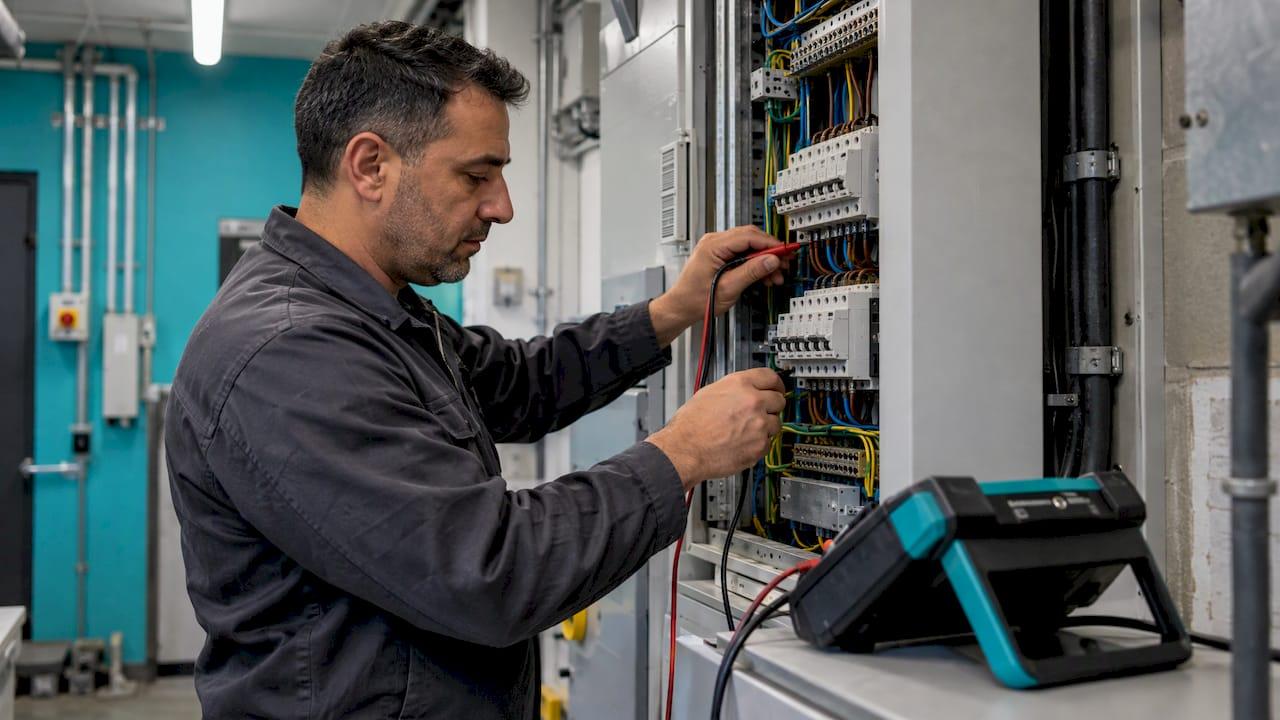
Fixed wire testing is the periodic inspection and testing of a building's permanent electrical installation, and it ends with a report called an EICR (Electrical Installation Condition Report). Employers must keep electrical systems safe under the Electricity at Work Regulations 1989, and landlords of privately rented homes have explicit five-year testing duties. This guide explains what is tested, what the law says, how often to book it, what the report codes mean and how to choose a competent tester.
TL;DR
- Fixed wire testing checks the wiring and fixed equipment built into a building. The EICR is the report that records the result.
- For employers, the duty to maintain electrical systems safely comes from the Electricity at Work Regulations 1989. Private landlords have specific five-year inspection rules.
- Intervals are set by the type of premises, its use and its condition. Three to five years is a common recommendation for workplaces, and the inspector can shorten it.
- Defects are coded C1, C2, C3 or FI. C1 and C2 need prompt remedial work before the report can be called satisfactory.
- Portable appliances are not part of the fixed wire test. They are covered by PAT, which we can schedule in the same visit.
Table of Contents
- What fixed wire testing actually is
- What is inspected and what the visit involves
- Is fixed wire testing a legal requirement?
- How often fixed wire testing should be carried out
- What the EICR tells you: C1, C2, C3 and FI
- Who can carry out fixed wire testing
- What affects the price of a fixed wire test
- Our perspective: treat compliance as one scheduled service
- Book fixed wire testing with National Test Services
- FAQ
- Sources
What fixed wire testing actually is
Fixed wire testing is the everyday name for what the wiring regulations call periodic inspection and testing. An electrician inspects the permanent installation, runs a set of electrical tests on it, and records its condition against BS 7671, the UK wiring standard. The aim is to confirm the installation is safe for continued use.
The search terms people use for it overlap, so here is how they fit together:
- Fixed wire testing, fixed wiring testing, fixed electrical testing: the same activity described in slightly different words.
- Periodic inspection and testing: the formal technical name, as explained in a general UK guide.
- EICR: the document produced at the end. The test is the work done on site, and the EICR is the certificate-style report that records what was found.
The purpose is condition reporting. Electrical Safety First's guidance makes the point that a periodic inspection is not a fault-finding exercise: it assesses and reports on the installation's condition within an agreed extent and set of limitations. The ECA describes the goal as finding any damage or defects that could cause danger from shock, fire or explosion, so that the system is safe in situ and safe to use.
What is inspected and what the visit involves
The HSE says fixed installations should be inspected and tested across circuits from the meter and consumer unit, supplying light switches, sockets and wired-in equipment such as cookers. In a commercial or industrial building that usually means:
- the incoming supply, main switchgear and distribution boards
- consumer units and their protective devices
- circuit wiring, accessories, switches, sockets and lighting circuits
- earthing and bonding arrangements
- fixed, hard-wired equipment connected to the installation
The tests themselves vary by building. Because the installation is already live and in use, a periodic inspection has no fixed sequence of mandatory tests. The inspector chooses from options such as polarity checks, earth fault loop impedance, RCD testing and protective conductor continuity.
What a visit looks like in practice
- Scope agreed. You and the tester agree which distribution boards and areas are covered, and any limitations (for example, circuits that cannot be switched off).
- Visual inspection. The engineer examines boards, cabling, accessories and signs of damage, overheating or unsafe alterations.
- Testing. Circuits are tested, often one at a time. Because power to circuits must be isolated briefly, good planning keeps disruption low. Tests in offices, schools and healthcare sites are often scheduled out of hours or in sections.
- Report. Findings are recorded on the EICR with a code for each observation.
- Remedial work. Anything coded as urgent is put right and the installation is confirmed as satisfactory.
One boundary matters. Anything connected by a plug is not part of fixed wire testing. It belongs to Portable Appliance Testing, which has its own scope and records. Many sites book both in a single programme so the paperwork lines up.
Is fixed wire testing a legal requirement?
The honest answer is that it depends on who you are, and the wording of the law differs between workplaces and rented homes.
Workplaces and employers
The Electricity at Work Regulations 1989 require precautions against the risk of death or personal injury from electricity in work activities. Systems must be maintained to prevent danger so far as is reasonably practicable. The HSE's guidance on the regulations adds that inspection and, where necessary, testing is an essential part of any preventive maintenance programme.
The regulations do not name a fixed wire test or set a number of years. In practice, periodic inspection and testing to BS 7671, reported on an EICR, is how most employers show they have met the duty. The ECA notes that Regulation 3 puts the responsibility on the employer, and that Regulation 16 requires the person doing the work to have sufficient technical knowledge, skills and experience for the installation. Insurers and licensing authorities often ask for a current EICR too.

Private landlords
For rented homes, the duty is explicit:
- England: the Electrical Safety Standards in the Private Rented Sector Regulations require inspection and testing, with a satisfactory report, at intervals of no more than five years. It applied to new tenancies from 1 December 2022 and existing tenancies from 1 December 2023.
- Scotland: statutory guidance published on 31 January 2024 says landlords must arrange periodic inspection and testing by a competent skilled person before first letting, then at intervals of no more than five years.
- Tenants: NICEIC advises that landlords must also provide tenants with a copy of the EICR.
Rules differ across the UK nations and can change, so check the current requirement for the nation your property is in. Housing associations and social landlords have their own sector requirements, which a managed testing contract can be set up around.
How often fixed wire testing should be carried out
There is no single legal interval for workplaces. The IET states that the interval is determined by the type of installation and equipment, its use, the quality of maintenance and external influences. It also confirms that the initial frequencies in IET Guidance Note 3 are recommendations, not legal requirements.
The ECA's guide gives a practical starting point:
| Type of premises | Recommended interval |
|---|---|
| Industrial, agricultural and public buildings, sports and leisure facilities, or where a local authority licence requires it | 3 years |
| Commercial and educational premises, and certain residential premises (not domestic) | 5 years |
Those figures come from the ECA's technical guide. Treat them as a baseline. The inspector can recommend a shorter period, and Electrical Safety First's guidance says the same for rented homes: at least every five years, or sooner if the inspector concludes it is necessary.
Some reasons to test earlier than the baseline:
- a change of occupier or use of the building
- major alterations, extensions or new machinery
- a previous report with C2 or FI observations
- harsh environments such as damp, dust, heat or vibration
- a licence, lease or insurance condition that sets its own interval
What the EICR tells you: C1, C2, C3 and FI
The inspector records every observation on the EICR and gives it a classification code according to urgency. The IET sets out the codes:
| Code | Meaning | What it means for you |
|---|---|---|
| C1 | Danger present, risk of injury | Immediate remedial action |
| C2 | Potentially dangerous | Urgent remedial action |
| C3 | Improvement recommended | Plan the work at a convenient time |
| FI | Further investigation required | Investigate without delay |
The definitions are in the IET's inspection and testing FAQs. The IET's model EICR form also shows what else the report holds: supply characteristics and earthing arrangements, particulars of the installation, the observations and the overall outcome.
If the inspector finds a C1, they must tell you straight away and also in writing. Electrical Safety First's guidance explains that this action is needed to satisfy the duties under the Health and Safety at Work etc Act 1974 and the Electricity at Work Regulations 1989. In practice, treat C1 and C2 items as jobs to book straight away, record the date they were fixed, and keep the updated paperwork with the original report.
C3 items do not make a report unsatisfactory, but a sensible maintenance plan logs them and schedules them before the next test. A clear action list is what turns an EICR from a filing exercise into a maintenance tool.
Who can carry out fixed wire testing
The work must be done by a competent person. BS 7671 defines a skilled person as someone with adequate education, training and practical skills who can perceive risks and avoid hazards that electricity can create. The IET also says the tester needs comprehensive knowledge and experience of different types of installation.
SELECT's guidance gives a useful checklist of minimum competence. The person should have sufficient knowledge and experience to avoid injury, understand the current edition of BS 7671 including inspection, testing and reporting, and be skilled in using the test instruments safely. Industry bodies also expect an electrical installation qualification at NVQ Level 3 or equivalent, plus a specific inspection and testing qualification, as one technical bulletin sets out.
When you choose a provider, ask:
- Which qualifications do the engineers who will attend hold in inspection and testing?
- Are the test instruments calibrated?
- What will the report contain, and how quickly will you receive it?
- Is the quote fixed, and what does it assume about access and the number of boards?
- Can the provider handle remedial work and other compliance testing, so you deal with one company?
What affects the price of a fixed wire test
Price depends on the size and complexity of the installation, so a sensible quote starts from a count rather than a guess. The main drivers are:
- the number of circuits and distribution boards
- the floor area and the number of separate buildings or units
- the age and condition of the wiring, since older installations can take longer to test
- access, working hours and how many areas must be shut down in turn
- how much remedial work follows from the report
Because these vary so much from building to building, we give fixed-price quotes rather than ranges. Send us the details of your site through our services page and we will price the work. Our published call-out fee is £120 one-off, and our pricing calculator gives estimates for PAT and EET testing.
Our perspective: treat compliance as one scheduled service
Most of the problems we see are not caused by a failed test. They come from compliance work that is scattered: wiring tested in one year, portable appliances in another, fire alarms and emergency lighting handled by someone else, and records kept in three places.
That is why we offer managed contracts that bring fixed wire testing (EICR), PAT and EET, fixed appliance testing and fire safety into a single scheduled service. One calendar, one point of contact, and one set of records. Our engineers are certified and work with calibrated instruments, and we aim to issue certificates within 24 to 48 hours of testing, so you are not waiting weeks to act on findings.
We also keep a digital asset register and a certificate portal, so you can find the last report in seconds when an insurer, auditor or inspector asks. For schools, healthcare sites, offices, industrial units and landlords, that evidence is often as valuable as the test itself.
Our advice: read every EICR as a maintenance plan. Book C1 and C2 remedial work immediately, diarise C3 items, and set the next test date before the engineer leaves site. If we can quote it in advance at a fixed price, there are no surprises on the day.
the author
Book fixed wire testing with National Test Services
We carry out Fixed Wire Testing (EICR) for businesses, landlords, schools, healthcare and industrial sites across the United Kingdom. The same visit programme can include PAT, fixed appliance testing, fire alarm and emergency lighting tests, fire extinguisher servicing and rewiring works if the report calls for it.

See everything we cover on our electrical and fire safety services page, or start with a PAT and EET estimate if you also need portable appliances tested. You can find out more about the company on our home page.
FAQ
Is fixed wire testing the same as an EICR?
Not quite, though the terms are often used interchangeably. Fixed wire testing is the inspection and testing work carried out on site. The EICR is the report that records the condition of the installation and any coded observations. When someone asks for a fixed wire test, an EICR is what they receive at the end.
Is fixed wire testing a legal requirement for businesses?
Employers must keep electrical systems safe under the Electricity at Work Regulations 1989, and the HSE says inspection and testing is an essential part of preventive maintenance. The regulations do not set a fixed number of years for workplaces. Private landlords, by contrast, have a specific requirement to test at least every five years.
How long does a fixed wire test take?
It depends on the number of circuits, boards and areas. A small unit may take part of a day, while a school or industrial site is usually split over several days and planned around operations. Power to circuits is isolated briefly during testing, so agree the sequence in advance to keep disruption low.
What happens if my EICR is unsatisfactory?
A C1 or C2 observation means remedial work is needed. A C1 means danger is present and action is immediate, while C2 means urgent action. Once the work is done, the installation is confirmed as satisfactory and the paperwork is updated. Items coded FI need further investigation without delay.
Does fixed wire testing cover portable appliances?
No. Fixed wire testing covers the permanent installation and hard-wired equipment. Anything with a plug is covered by Portable Appliance Testing. Most sites book both together so the schedules and records stay aligned.
Sources
- Introduction to electrical safety, HSE
- The Electricity at Work Regulations 1989: Guidance on Regulations (HSR25), HSE
- Inspection and Testing FAQs, IET BS 7671 guidance
- Model forms for certification and reporting (EICR), IET
- The Employer's Legal Duties: Safe Electrical Installations, ECA
- Electrical Safety Standards in the Private Rented Sector, Best Practice Guide 10, Electrical Safety First
- Electrical Installation Condition Reporting, Best Practice Guide 4, Electrical Safety First
- Electrical Installation Condition Reporting, Best Practice Guide 4, SELECT
- Annex D3: Installations for the supply of electricity, Scottish Government
- Current Private Rented Sector Legal Requirements, Electrical Safety Roundtable
- Electrical Installation Condition Reports, NICEIC
- Fixed Electrical Installation Inspection and Testing, RiskStop
- What Is Fixed Wire Testing? EICR Guide for UK Buildings